
AWDB speaks with Yen Hui Teng, curator and manager at Singapore Art Museum (SAM) in light of the ongoing exhibition ‘Everyday Practices’. The exhibition showcases a diverse range of contemporary art from Southeast Asia, bringing together both older and recent acquisitions from the museum’s extensive collection across many mediums.
Curated around the themes of “every day,” “repetition,” and “endurance,” many of the featured works are constructed through monotonous and tedious tasks. Through repetition, small and menial tasks express powerful statements of resilience and endurance, particularly regarding harsh political climates, prompting reflection on how collective strength can be found in individual actions.
‘Everyday Practices’ is the inaugural exhibition at SAM’s new collections gallery at Tanjong Pagar Distripark, marking a milestone in their commitment to contemporary Southeast Asian art and beyond.
As you have access to one of the largest collections of contemporary Southeast Asian art, how was the decision taken to curate this exhibition?
We wanted to highlight the diversity of artistic expression across the region while also bringing older and more recent acquisitions into dialogue with one another. The selection process centred on artworks that resonated with the exhibition’s interests in the “every day,” “repetition,” and “endurance,” exploring the fundamental conditions of life and its meaning.
From SAM’s collection, 19 artists and one artist collective representing ten countries across Asia were chosen, including internationally renowned figures like Tehching Hsieh, Melati Suryodarmo, Apichatpong Weerasethakul, Maria Taniguchi, and Sun Xun. These works span different generations and media, offering a comprehensive perspective on contemporary art from Asia.
By bringing together diverse artistic practices and cultural viewpoints, ‘Everyday Practices’ provides a thought-provoking exploration of how art can be a powerful tool for resilience, addressing personal, societal, and political challenges. The exhibition reflects SAM’s commitment to showcasing the region’s dynamic and evolving art landscape while creating meaningful connections between art, artists, and audiences.
Why have you chosen Tehching Hsieh’s philosophy as the foundation for this exhibition, and could you provide some examples of how the works you’ve chosen tie into his themes of repetition, the passing of time, and mundane everyday activities?
Tehching Hsieh inspires us to think about art making and living in different and often inseparable ways. His performances strip art down to its most fundamental elements – time, space, action, and presence. His philosophies invite us to reconsider the profound in the seemingly mundane as he tests the physical and psychological limits of human endurance with everyday routines. ‘One Year Performance 1978-1979’, in which he endured solitary confinement and strict abstinence from everyday interactions, encapsulates themes of repetition, the passage of time, and the weight of mundane activities. These resonate deeply with the ways in which we were thinking about repetitive actions and daily routines that can transform into acts of resilience, reflection, and resistance.
One artwork that exemplifies this is ‘Untitled’ by Maria Taniguchi, where she meticulously outlines and paints a brickwork pattern over the entire surface of the canvas. The repetitive act of drawing each brick mirrors the persistence and monotony of daily labour. At the same time, the subtle tonal shifts in the paint mark the slow, almost imperceptible passage of time.
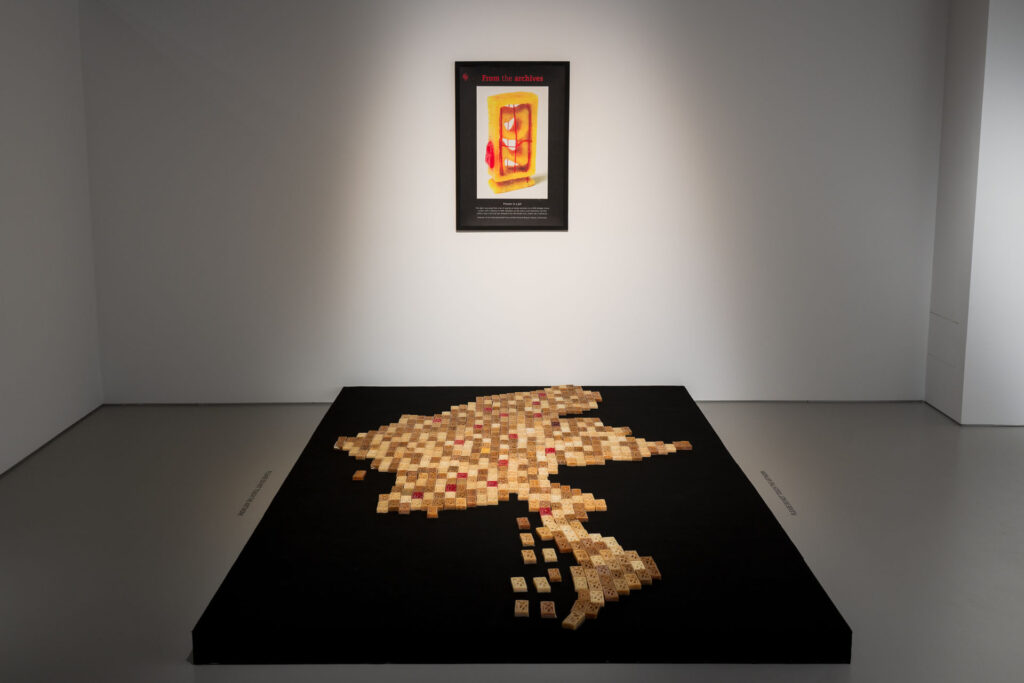
Similarly, ‘Soap Blocked’ by Htein Lin furthers these themes through his hand-carved soap blocks, arranged to form a map of Myanmar. Each block’s tiny, encased figure symbolises his personal imprisonment experience and the collective struggles under political oppression. The act of carving soap — an ordinary object that he encountered during his time in incarceration — becomes a poignant metaphor for resilience against dehumanising forces, tying into the repetitive and mundane as a tool for profound expression.
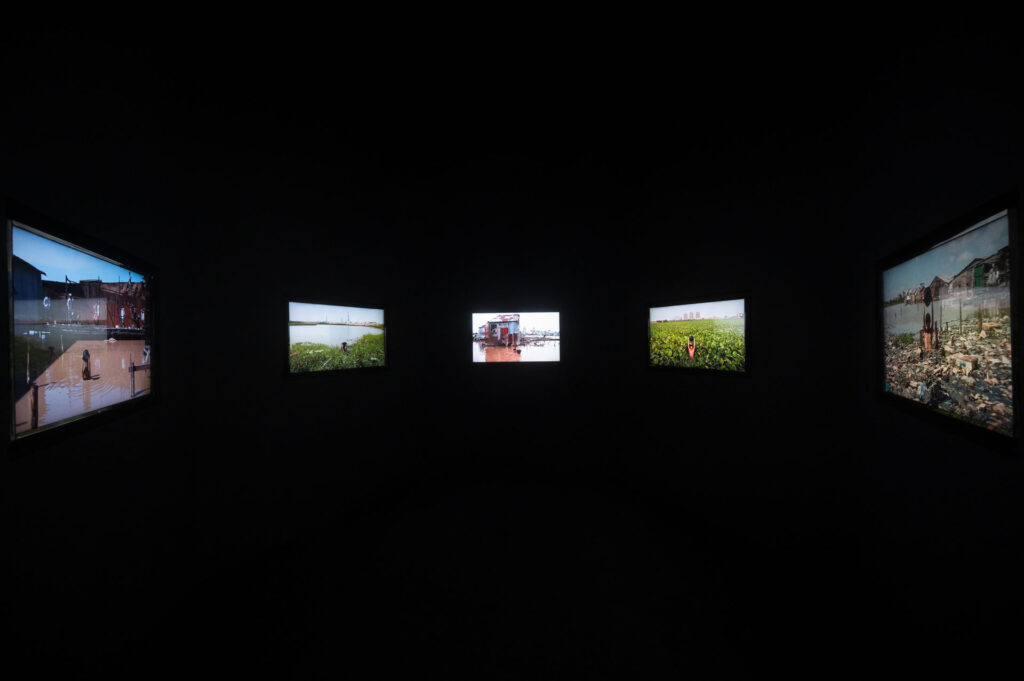
Khvay Samnang also embodies these concepts in ‘Untitled’, a video installation documenting the repetitive act of the artist pouring a bucket of sand over himself in various lakes around Phnom Penh. This futile yet powerful gesture critiques the displacement of communities due to urban development, underscoring how repetitive acts can express resistance and lament in the face of systemic exploitation.
Drawing on Hsieh’s philosophy, this exhibition reveals how endurance, repetition, and the everyday can become deeply meaningful. It offers insights into the resilience of the human spirit in navigating both personal and collective challenges.
As performance art is meant to be ethereal, were there any challenges in presenting the documentation of those works and portraying the time that went into creating them?
Performance art inherently resists permanence, which is part of its power – it exists in the moment, rooted in presence and lived experience. Any performance piece inevitably loses some of this “live-ness” when re-presented in a different form. Documentation to me is not about replicating the performance but rather creating a trace that speaks to its essence. While the performance may be over, documentation allows the work to continue its dialogue with the world while acknowledging that the original performance can only exist in memory. The challenge — and perhaps the beauty — lies in accepting this duality: the work is both preserved and altered through documentation.
Do you see the art in the exhibition as a reflection of political struggles or as a tool for political change?
They could be seen as either or both, depending on how we interpret each artist’s gestures and their contexts.
As an example, ‘Soap Blocked’ reflects Htein Lin’s personal history of incarceration for political dissent, highlighting the struggle and collective helplessness felt by the citizens of Myanmar under military rule. But the original bar of soap that he made while in prison was successfully smuggled out by a Red Cross Representative who visited, enabling the artist’s struggles to be amplified and heard by the rest of the world, offering an opportunity for action.
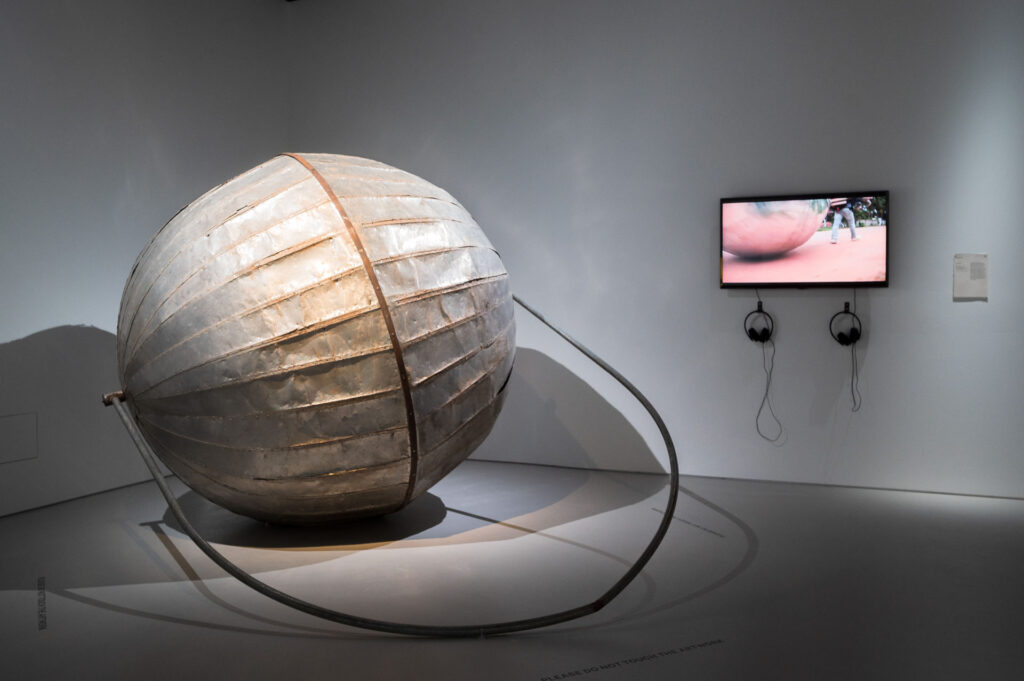
‘Mon Boulet’ by Svay Sareth symbolises the heaviness that lingers in Cambodian society from the Khmer Rouge regime. The artist’s grueling 250-kilometre journey, dragging an 80-kilogram metal ball, serves as a metaphor for the resilience of the human spirit while also addressing the enduring legacies of trauma and oppression in Cambodia. This piece speaks to both personal and collective endurance.
Wong Hoy Cheong’s ‘Tapestry of Justice’ goes a step further by turning political action into an artwork. With over 10,000 photocopied thumbprints collected during Malaysia’s Reformasi movement, the piece reflects both a struggle and collective call for justice, highlighting the significance of collective action in driving political change.
In this way, the exhibition showcases strategies of resistance and reflection through art.
‘Everyday Practices’ is currently on show at Singapore Art Museum until 20 July 2025. For more information on this and other exhibitions, please click here.
INTERVIEW COURTESY OF ART WORLD DATABASE AND YEN HUI TENG, NOVEMBER 2024.