AWDB speaks to renowned Burmese artist Htein Lin regarding his ongoing solo exhibition ‘Escape’ at Ikon Gallery in Birmingham. Known for blending painting, performance, and installation with personal and political testimony, Lin’s practice has reflected the lived reality of Myanmar’s struggle throughout his career.
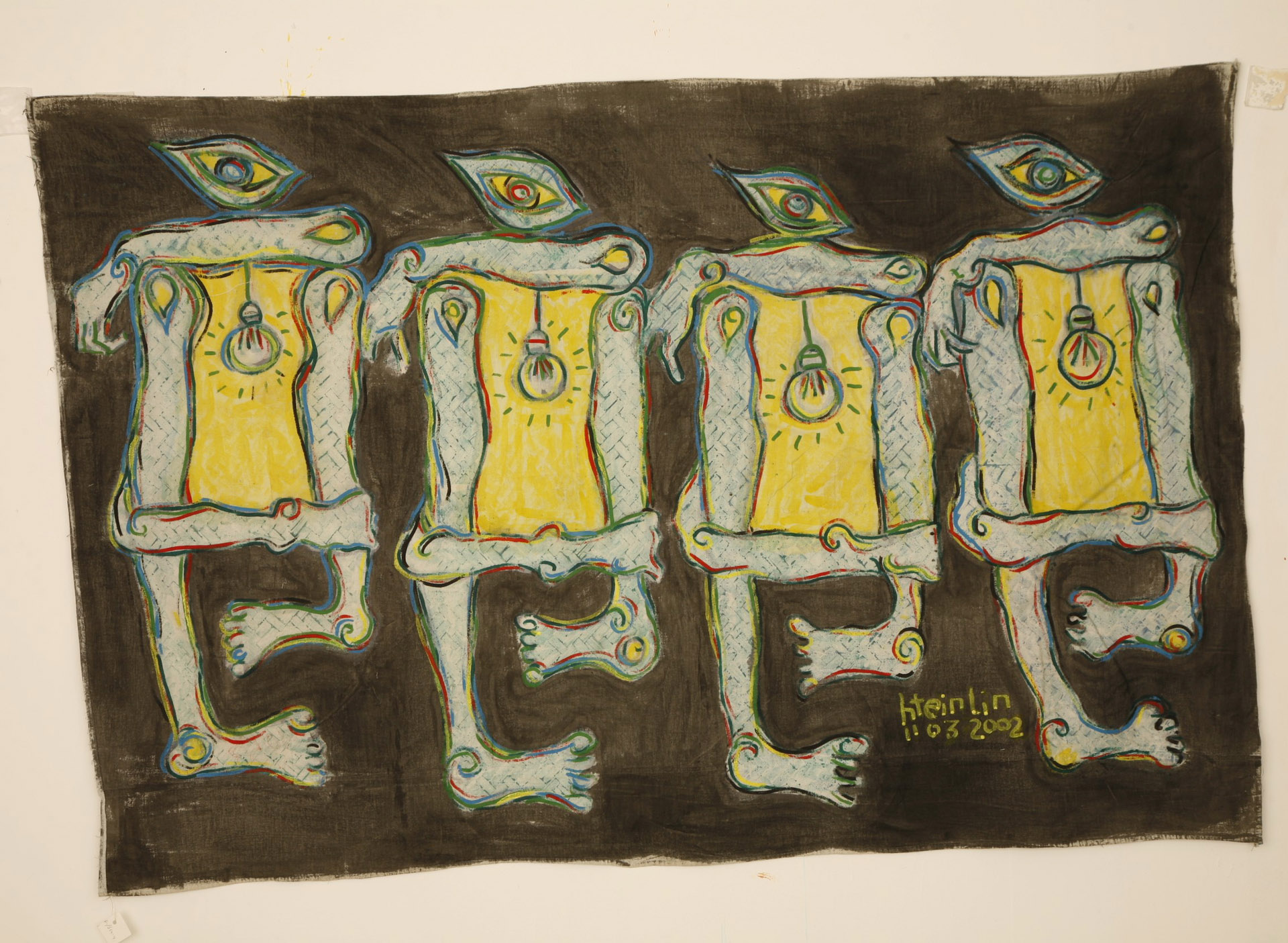
At the core of the show is ‘000235’, a collection of paintings Lin created during his political imprisonment from 1998 to 2004. Made with smuggled pigments and found materials, ‘Escape’ is the largest display of this series to date. Alongside archival drawings and self-portraits, the show includes recent works like the large-scale canvas ‘Fiery Hell’. Also presented are his collaborations with residents at HMP Grendon, connecting disparate experiences of incarceration across borders from a distance, as the Myanmar authorities continue to refuse to renew Lin’s passport.
‘Escape’ is showing at Ikon until 1 June. For further insight into Htein Lin’s practice and the exhibition, see the upcoming talk with Vicky Bowman and Ikon curator Melanie Pocock on 17 May.
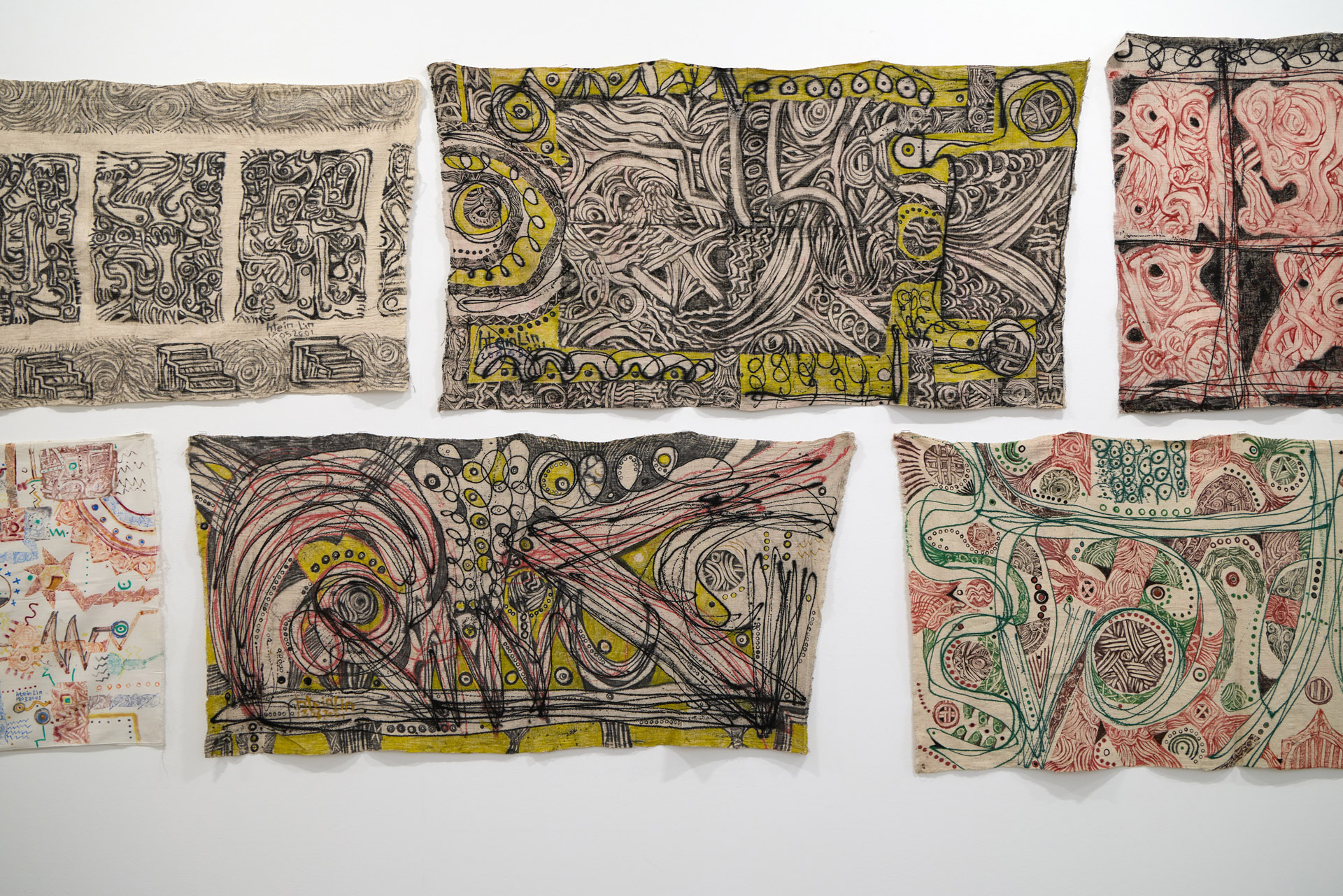
Htein Lin, ‘000235’, 1998-2004, installation view of ‘Escape’ at Ikon, Birmingham. Image courtesy of Ikon Gallery and the artist
It’s remarkable that works from ‘000235’ are now on display, especially considering how many didn’t make it out of prison. When creating this series, did you ever envision having them shown in a gallery setting?
When I started to paint these works in jail, my main motivation was to show that while they could lock me up, they couldn’t lock up my art. I had seen from magazines that made it into jail that some of my artist friends who weren’t imprisoned, like Aye Ko and Nyein Chan Su, were having solo shows. That inspired me to keep going too. I started to recruit some of the guards to my cause, and persuade them to bring in paints, but I could only do that by promising them that I wouldn’t write any political statements, and I would show them the work I was doing, to build trust. I also promised to arrange for the work to be smuggled out, and wait until I was released before I had a show. It would have been very dangerous for the guards, as well as me, if the paint or my paintings were found.
As I painted the series, I realised how important they were for me, as they were painted with absolute artistic freedom, even though I was imprisoned. I was free from all constraints of the market and censorship that I would have found outside. So I was confident that one day, these paintings would define my future as an artist. I just didn’t know when or where.
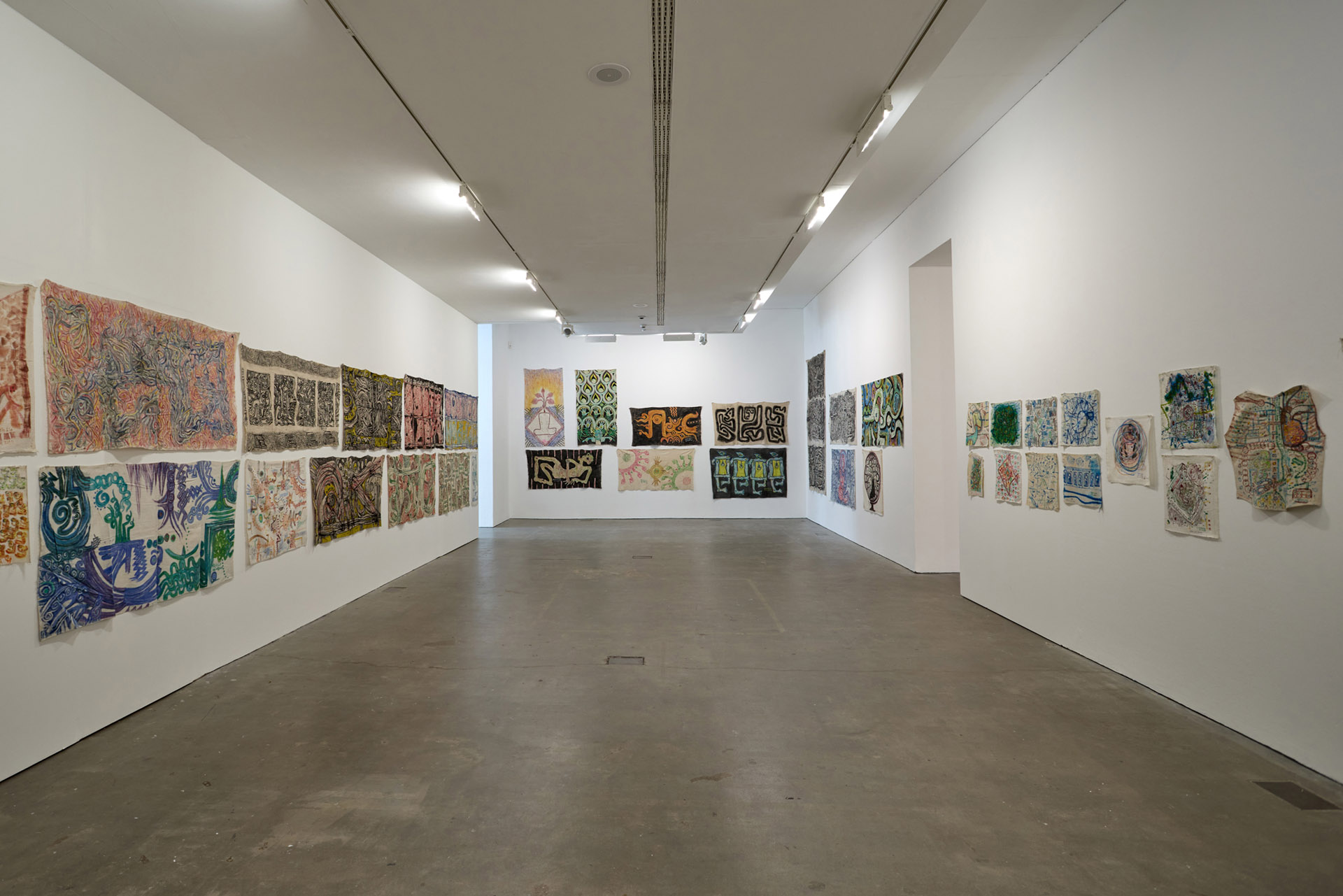
Htein Lin, ‘000235’, 1998-2004, installation view of ‘Escape’ at Ikon, Birmingham. Image courtesy of Ikon Gallery and the artist
Alongside the exhibition at Ikon, you’ve created a series of portraits with prisoners at HMP Grendon, where you recreated self-portraits they made in your style. The experiences you had in prison and those of the prisoners at HMP Grendon are very different. What parallels or differences do you see in their portraiture compared to the self-portraits you created as part of ‘000235’?
Detention elsewhere fascinates me as it has been such an important and repeated part of my own life and work. I have been detained several times in Myanmar, in different situations and conditions, in the jungle, in jail, in a government building which is now a five-star hotel that exhibits my art, and back in jail again.
I always take the opportunity to learn about others’ experiences of detention, and how art, and meditation, can help them as it helped me. When I lived in the UK, I was a judge for the annual Koestler Arts prize for several years, which gave me the chance to visit Wormwood Scrubs. So I know that conditions in British prisons, and particularly HMP Grendon, are very different to the places I was detained in Myanmar. But at the same time, I know that prisoners’ feelings of anxiety and separation, and the desire for freedom, are shared experiences wherever you are. These feelings were very visible in the charcoal self-portraits of prisoners I received via email from Grendon’s artist in residence, Simon Harris, and Ikon, and it was quite easy to reinterpret most of them in my style. And as I did, I remembered the first self-portrait I painted in 1999 while I was in Mandalay Jail, which was my way to reflect my feelings at the time.
As I can’t travel, I could not visit HMP Grendon for the opening of the show on 1 May, or talk directly to the prisoners, but hope to meet them in person one day soon, preferably in freedom.
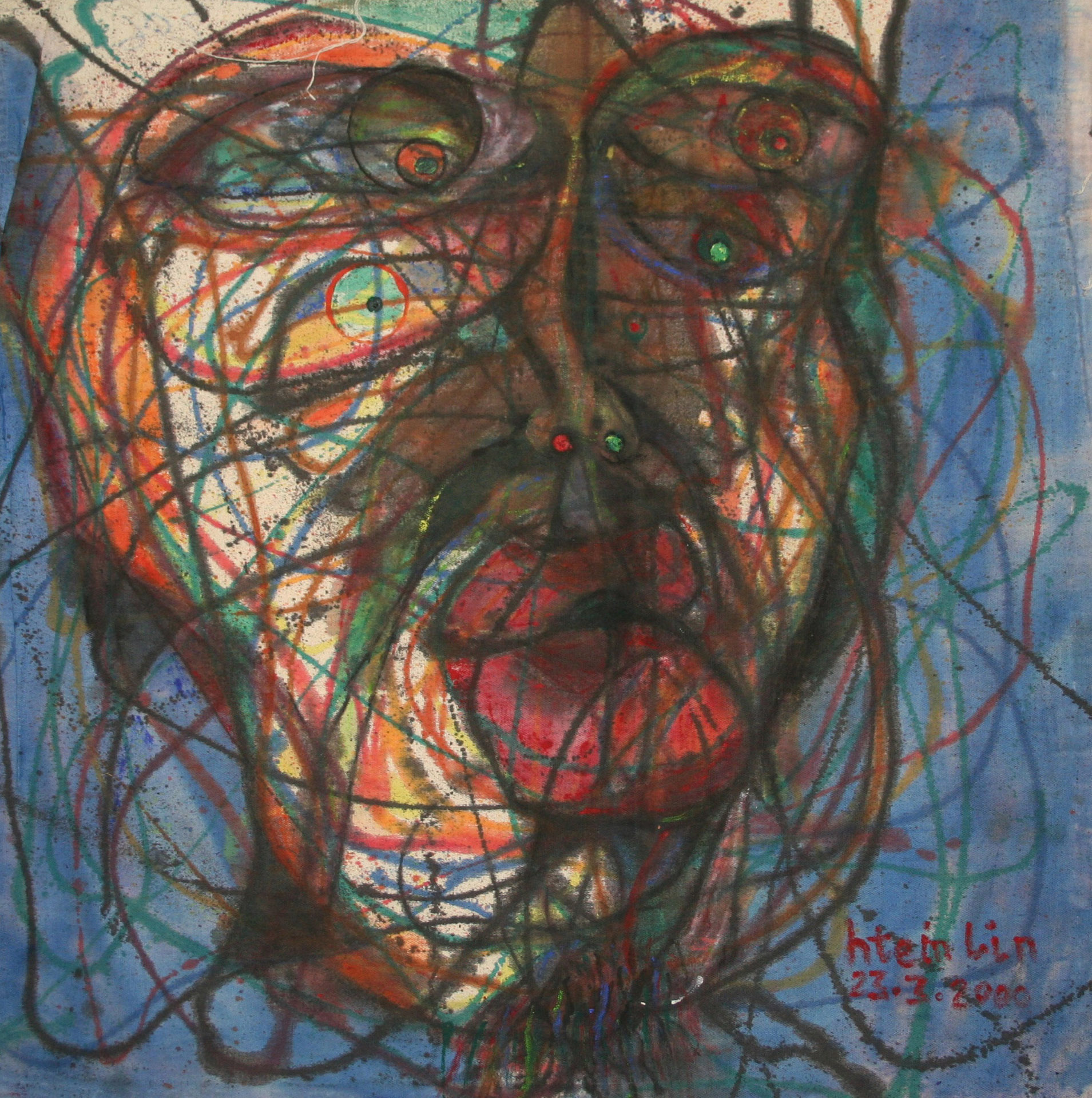
Htein Lin, ‘Self-portrait’, 2000, oil paint on textile. Image courtesy of Ikon Gallery and the artist
Given the current political climate in Myanmar, what is it like for the practice of a Burmese artist such as yourself today? And how does your work, such as ‘Fiery Hell’, reflect your personal experiences and the challenges faced by artists in this environment?
Our experiences as artists vary. I have stayed working in Myanmar. Indeed, I am unable to travel at the moment as I don’t have a passport. I can exhibit here occasionally, mainly in exhibitions connected to Embassy cultural programmes, as well as in the gallery we have built next to our house in the hill station of Kalaw. There are a number of other private galleries, mainly in Yangon. There isn’t much of a market, but they have some sales. Cultural initiatives like the British Council’s Connections Through Culture provide artists with some sponsorship and international exposure, including supporting my retrospective at IKON Birmingham. So it is challenging for most artists to make a living in Myanmar. But then again, it always was, and not just in Myanmar. As an established artist, I am luckier than most, and I continue to work on the projects that I want to pursue. But many artists have to focus on physical, economic and emotional survival.
Some Myanmar artists, particularly those who have aligned themselves with opposition movements, have moved overseas. Now it is not safe for them to come back. They often struggle, economically and emotionally, from being in exile. Through AMCA, the Association for Myanmar Contemporary Arts, which I co-founded with other artists just before the coup, we are trying to help everyone stay connected and motivated, build partnerships and promote arts education regardless of where we are based.
But the vast majority of people in Myanmar are struggling even more than the artists. They face endless man-made and natural disasters, most recently the massive earthquake at the end of March. In Myanmar Buddhism, there are Five Enemies of mankind (yan-thu-myo ngar-bar) which are water, fire, kings or leaders, thieves and malevolent people. On a daily basis I see people suffering from the impacts of these five enemies, and the war that they help to create. The suffering of the Myanmar people is something I try to document in paintings like ‘Fiery Hell’, just as Picasso did with ‘Guernica’.
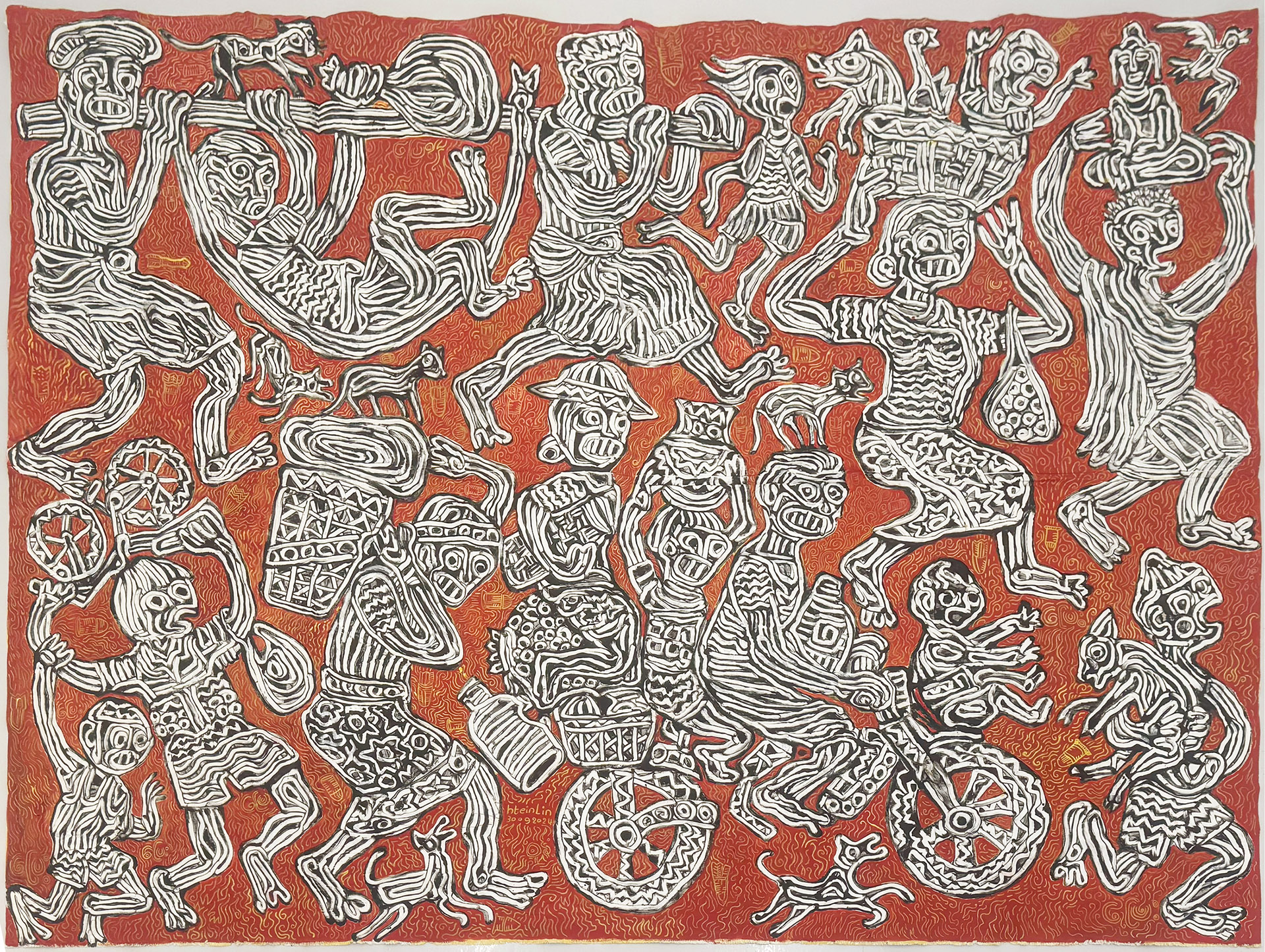
Htein Lin, ‘Fiery Hell’, 2024, acrylic on canvas. Image courtesy of Richard Koh Fine Art and the artist
I imagine one of the most common questions you receive is how you maintained the resolve and motivation to create art during your time in prison. Over the course of your career, your work has interrogated Myanmar’s ongoing conflict—how do you find the motivation to create art in such an oppressive environment, both inside and outside of prison?
Finding ways to overcome the challenge of creating art in jail was one of my main motivations for creating it. Identifying substitutes for canvas and brushes, from uniform and fragments of plastic, working out how to get paint or its equivalents smuggled in, and making the best of the materials I obtained were all part of the creative process. And sometimes I had to adapt the art form to match the materials available, and make music or write poetry or short stories, or develop performance art pieces. I experimented with different types of art to fit the situation and the opportunities.
Our prisoner community was tight-knit; our experiences were intense. But for many of them, art was something they were not familiar with and I wanted to expand their horizons. I took inspiration from our shared experiences, from the spiritual experience of the meditation practice I embarked on in jail, and used art to give deeper meaning to our constrained lives.
The show at Ikon curates your work in a way that separates pieces made during your imprisonment from those created after your release. How did your perspective shift between these two periods, and how has it influenced your practice?
Throughout the more than forty years that I have been making art, whether outside of jail or inside, in Myanmar or overseas, I have always been reacting to internal and external stimuli, and reflecting on material and cultural change. So at different times in my life, my art may be inspired by sexual desire, survival, fear, or a focus on self-awareness gained through meditation. I am inspired by the materials and the words I encounter, and the way these are changing. In Myanmar’s decade of democratisation between 2011 and 2021, I was interested in the shift to signboards cut from plastic instead of wood, paint and metal, reflected in my works called ‘Signs of the Times’. I observed changing attitudes towards gender and the taboo of mixing men’s and women’s clothing, which I documented in my series ‘Skirting the Issue’. I try and capture these trends in my art, so that it creates a different perspective on them, and I hope it encourages others to reflect on the material and societal change we are experiencing and debate them.
My work is always inspired by what I see happening around me, and happening directly to me. That might be cultural and societal change, or it might be environmental or political challenges. Sometimes it will be human rights abuses I have personally experienced, or it might be what I see happening to others at the moment, like the villagers fleeing from houses that are destroyed by civil war. I cannot and do not want to distance myself from these extreme experiences, and I want to document them so that they are not forgotten.
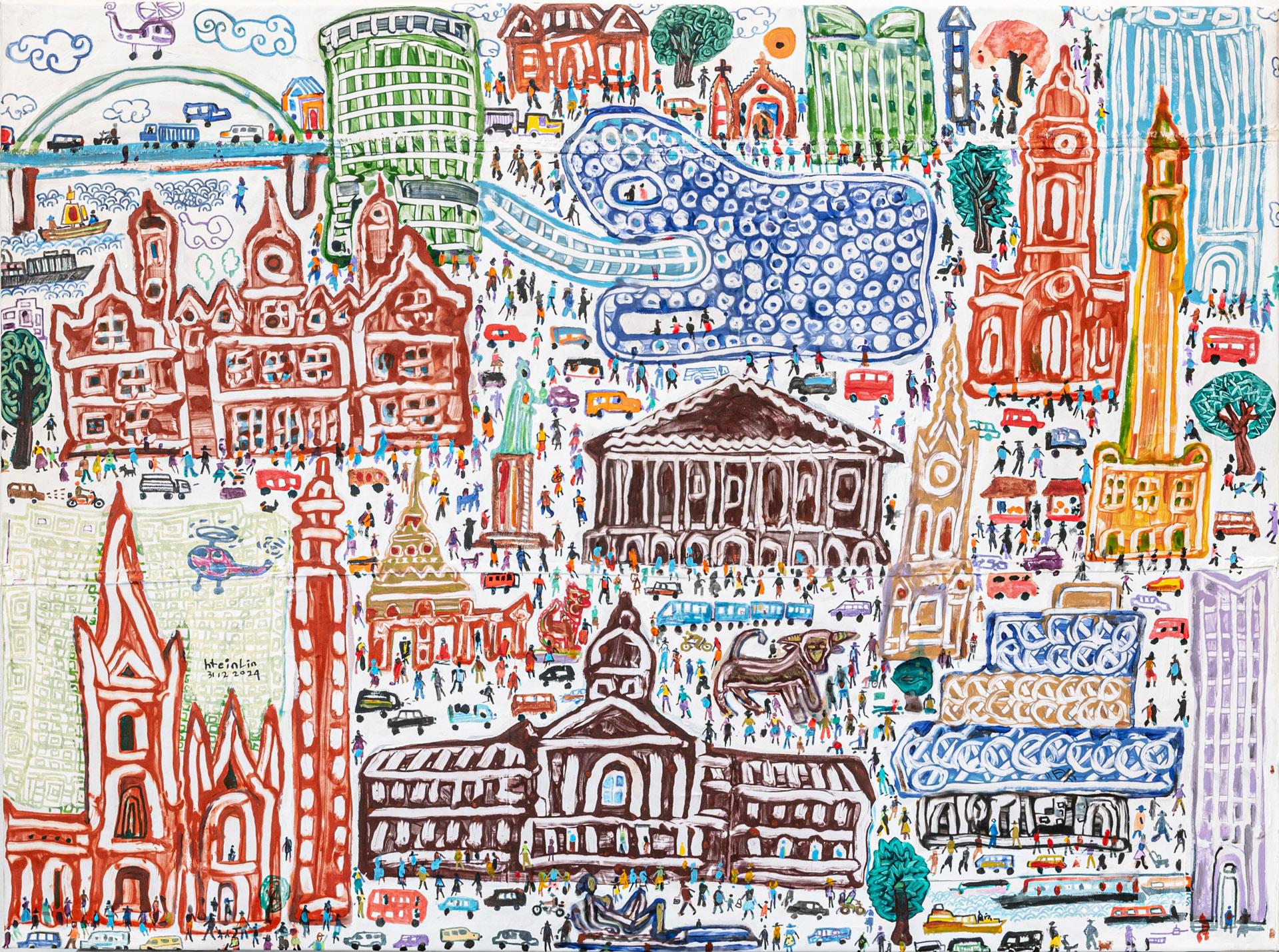
Htein Lin, ‘How do you find Birmingham?’, 2024, acrylic on canvas. Image courtesy of Ikon Gallery and the artist
‘Escape’ is on display at Ikon Gallery, Birmingham, United Kingdom until 1 June 2025. For more information, please click here. To attend the talk with Vicky Bowman, former British Ambassador to Myanmar and wife of artist Htein Lin, and Melanie Pocock, Artistic Director for Ikon, please click here.
INTERVIEW COURTESY OF ART WORLD DATABASE AND HTEIN LIN, MAY 2025.