[vc_row thb_divider_position=”bottom”][vc_column][vc_column_text]
AWDB speaks with artist and curator Desmond Mah preceding the launch of ‘The Other Singaporeans: Stories of Home and Identity’ on 16 August at JW Projects in Singapore. The group exhibition, curated by Mah, brings together artists whose ties to Singapore span naturalisation, former citizenship, migration, or diasporic connection, and reframing national identity among artists.
Featuring artists such as Milenko Prvački, Moses Tan, Emi Avora, Cynthia Delaney Suwito, and Weixin Quek Chong, the exhibition centres perspectives often overlooked in dominant narratives of Singaporeanness, particularly timely as the city-state approaches SG60, the 60th anniversary of Singapore’s independence. The show’s diverse visual language creates a dynamic dialogue across cultural differences.
How do you define the title ‘The Other Singaporeans’?
The title ‘The Other Singaporeans’ speaks to the many identities that exist alongside, and sometimes outside, the dominant narrative of what it means to be Singaporean. It acknowledges those whose experiences of home, belonging, and identity are shaped by migration, displacement, cultural hybridity, or living across borders. “Other” does not imply marginal or lesser, but different perspectives that broaden and enrich our collective understanding.
The title invites us to look beyond a state-defined idea of citizenship, recognising that Singaporeanness is not fixed, but a living, evolving conversation shaped by people who are not born in Singapore. Artists such as Milenko Prvački, Emi Avora, Leo Liu Xuanqi, Cynthia Delaney Suwito, and gallerist Wang Jingwei have each, at different points in their lives, made Singapore their temporary or permanent home and formed meaningful connections to the country. The exhibition also reflects on my own position as a former Singaporean citizen, questioning whether I am still Singaporean or not.
Could you walk us through some highlights of the exhibition?
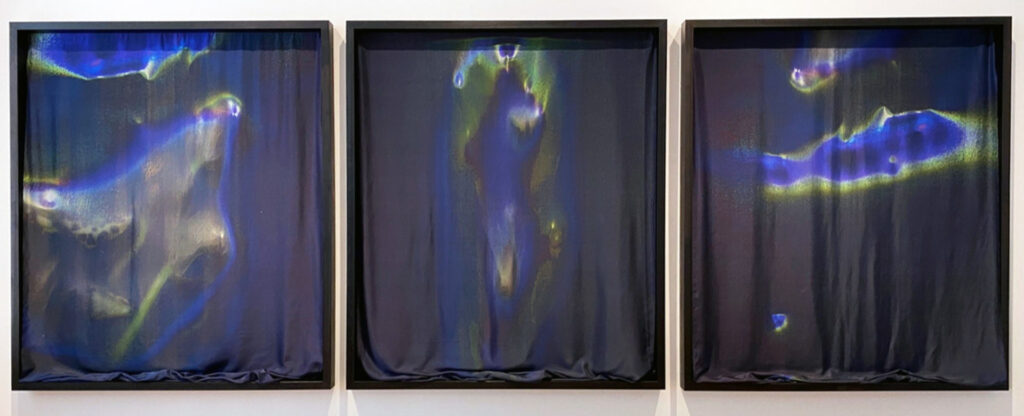
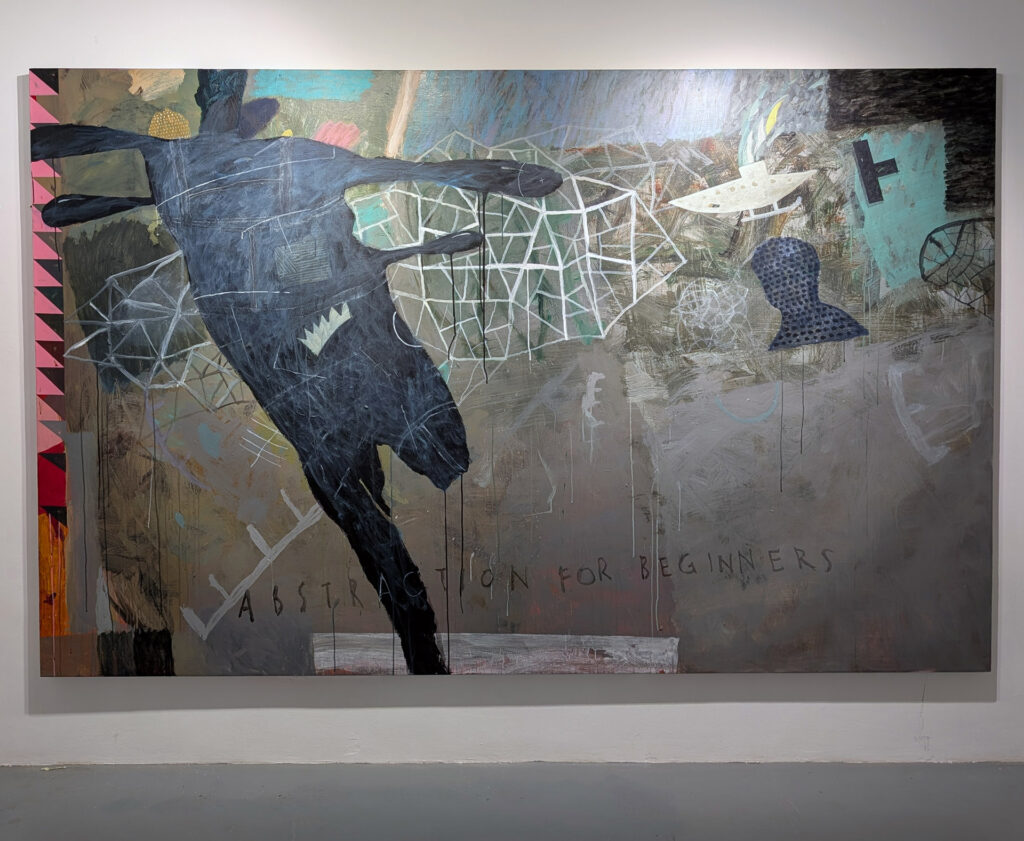
The highlights are the ways the works speak to each other visually, despite coming from very different cultural and personal contexts. There is strong content and material diversity, from Weixin Quek Chong’s silk‑printed photographs and Milenko Prvački’s layered abstractions to Emi Avora’s juxtaposed landscapes and Cynthia Delaney Suwito’s sculptural storage installation. Another highlight is how the exhibition plays with movement through space.
Moses Tan’s layout encourages the viewer to discover found objects, while Faris Nakamura’s works unfold like a pictorial storybook, creating shifting perspectives. The show also opens space for subtle self‑reflection and an expanded viewing experience, whether through the symbolic language in Leo Liu Xuanqi’s works or my own painting that embed humorous audio as a way to cushion sensitive ideas. Finally, the inclusion of artists living and working across the world brings an international dimension that feels dynamic and connected, while still grounded in the Singapore story.
We interviewed Moses Tan in April for his graduate showcase at Goldsmiths. Could you share a bit about what he’s presenting for this show?
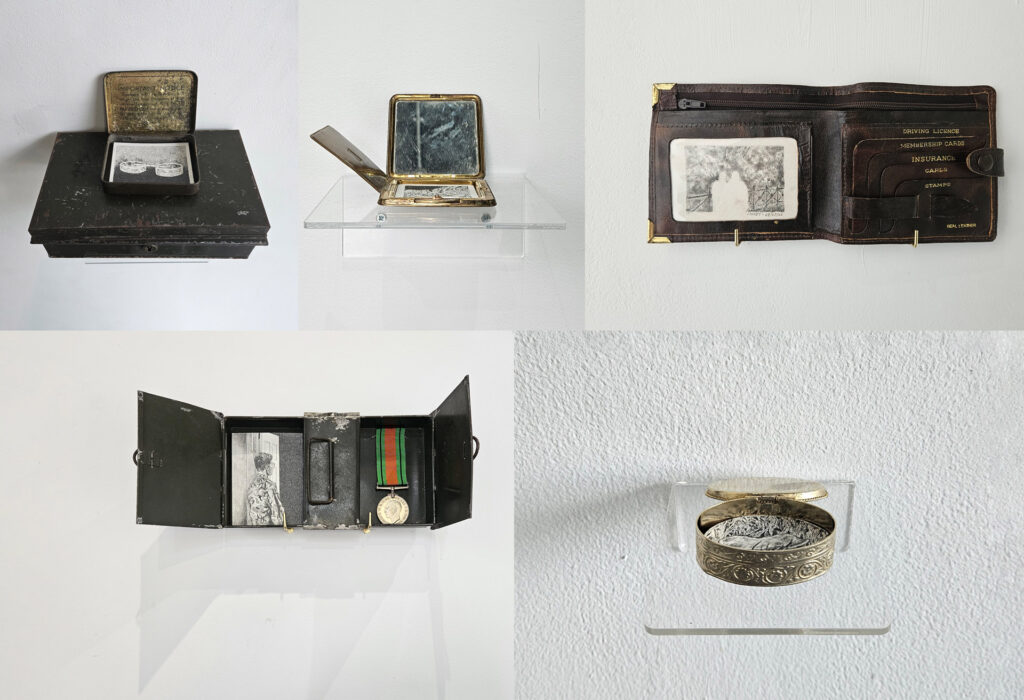
Exhibiting in ‘The Other Singaporeans’, Moses Tan’s drawing series ‘Awkward Contact’ explores queerness, hidden intimacies, and the embodied legacies of colonial rule. Drawing on acts of cruising and fleeting encounters, the works reflect how queer identities have been shaped by, and have resisted, Singapore’s inherited social codes. Scattered across the exhibition space and fused with found objects, the works prompt viewers to search, peer, and navigate, implicating them in an act of looking that mirrors the tensions of visibility, belonging, and marginality. Tan’s practice foregrounds queerness as a mode of being that sits uneasily within dominant national narratives, expanding the exhibition’s rethinking of fixed Singaporean identity.
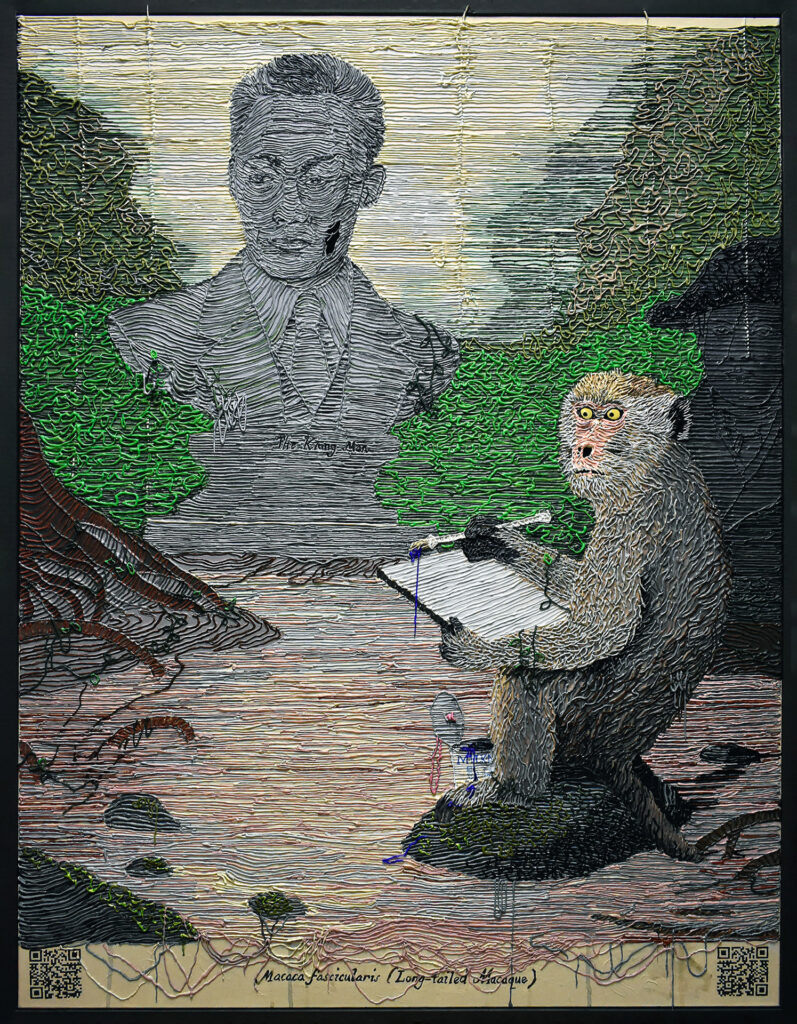
Your work ‘Still Living Rent-Free’ expresses hesitation towards displaying political views openly, using a macaque and AI voice to speak indirectly. How did you think about balancing personal expression with a kind of necessary distance?
That balance came quite naturally because it reflects how I have learned to shift expression as someone connected to Singapore but also living outside it. There is always a tension between wanting to speak plainly and recognising the realities of consequence, self-censorship, and the weight of social expectations. Using the macaque as a stand-in allowed me to approach these ideas indirectly, with humour and metaphor providing a kind of protective distance. I am a fan of Philomena Cunk, the fictional satirical presenter created by British comedian Diane Morgan, known for her absurd, deadpan commentary on serious topics in a mock documentary style. The AI voice in this work borrows that approach, adding humour that softens the seriousness without erasing it. In this way, the work becomes both personal and slightly removed, reflecting how critique often needs to operate when addressing sensitive issues tied to identity and free speech.
How do you see this show fitting into or resisting the cultural programming typically associated with SG60?
This show resists the usual cultural programming of SG60 by shifting focus away from a single, celebratory narrative of nationhood. While SG60 will likely highlight unity, progress, and milestones, ‘The Other Singaporeans’ offers a counterpoint by centring voices that exist on the periphery of that story. It opens space for complex, sometimes uneasy conversations about belonging, identity, and displacement. In doing so, it expands the scope of what commemorating SG60 could mean, suggesting that reflection on 60 years of independence should also include perspectives that question and complicate the dominant narrative.
The exhibition challenges the idea of a singular, nation-centric voice by making space for perspectives that are often left out of the dominant narrative. The Singaporean art scene is not moving in one fixed direction. While some state-led initiatives emphasise national identity, there are many artists and platforms actively engaging with diverse, complex, and sometimes difficult conversations about what it means to be Singaporean. ‘The Other Singaporeans’ positions itself firmly in this space, showing that identity here is plural, shifting, and open to debate.
Goh Wei Hao’s essay Singapore Art History as a History of Mobilities, which anchors the exhibition, is a useful reminder that Singapore’s art history has always been shaped by movement. The flow of people, ideas, and cultural exchanges, from the time of Singapore’s colonial port city days to the present, has kept the art landscape dynamic. This history challenges the notion of a static, inward-looking narrative. Singaporean artists such as Faris Nakamura, Moses Tan, and Weixin Quek Chong, who live and work abroad, continue to expand their practices in conversation with different cultural contexts while maintaining links to Singapore. In this light, Singapore’s art is not moving in a single nation centric direction, but continues to be shaped by a wide and evolving network of mobilities.
Desmond Mah’s ‘The Other Singaporeans’ opens at JW Projects, Singapore, on 16 August and is on display until 28 September. To RSVP to the opening, please click here, and find more information on the show and Desmond’s work here.
INTERVIEW COURTESY OF ART WORLD DATABASE AND DESMOND MAH, AUGUST 2025.
[/vc_column_text][/vc_column][/vc_row]