
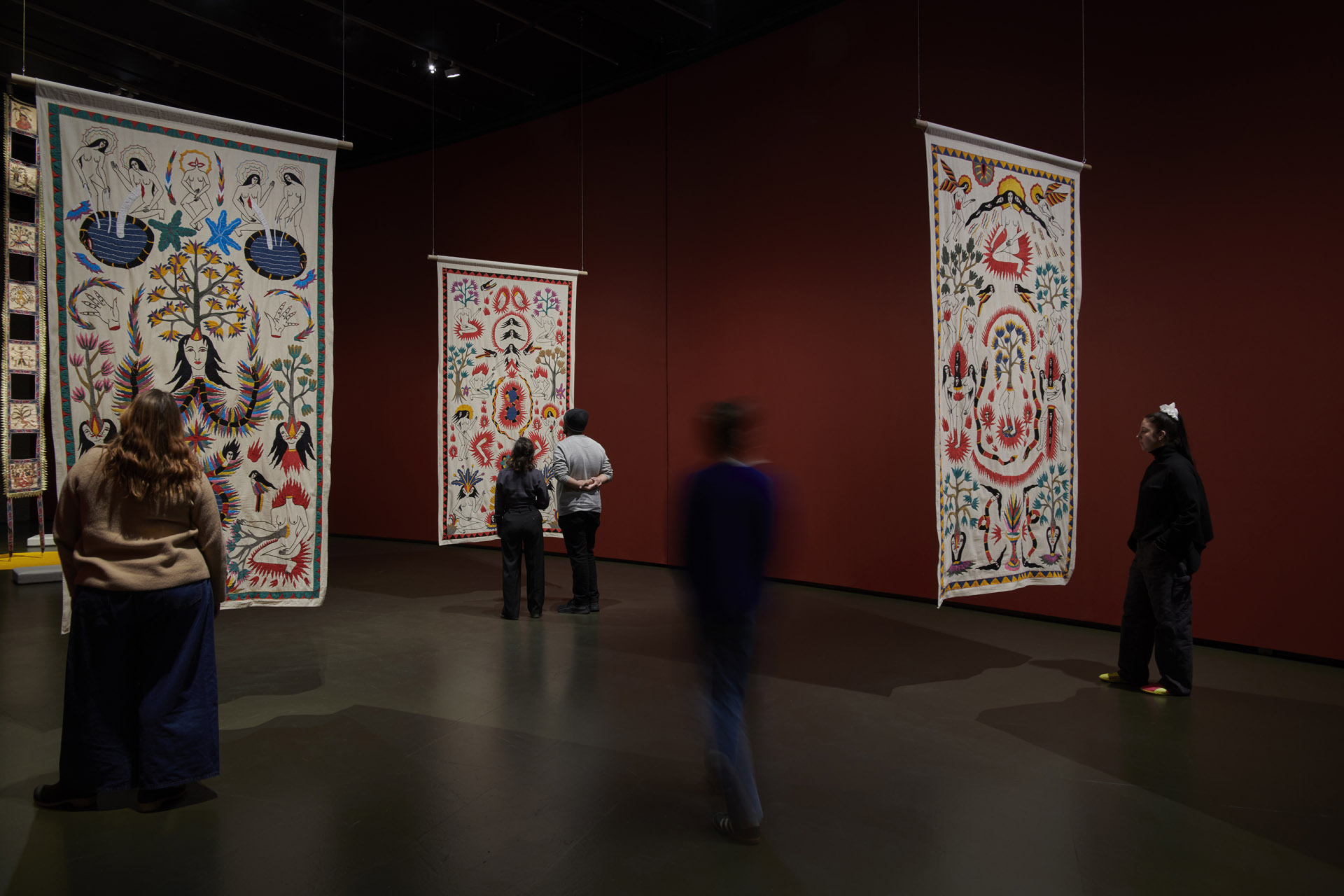
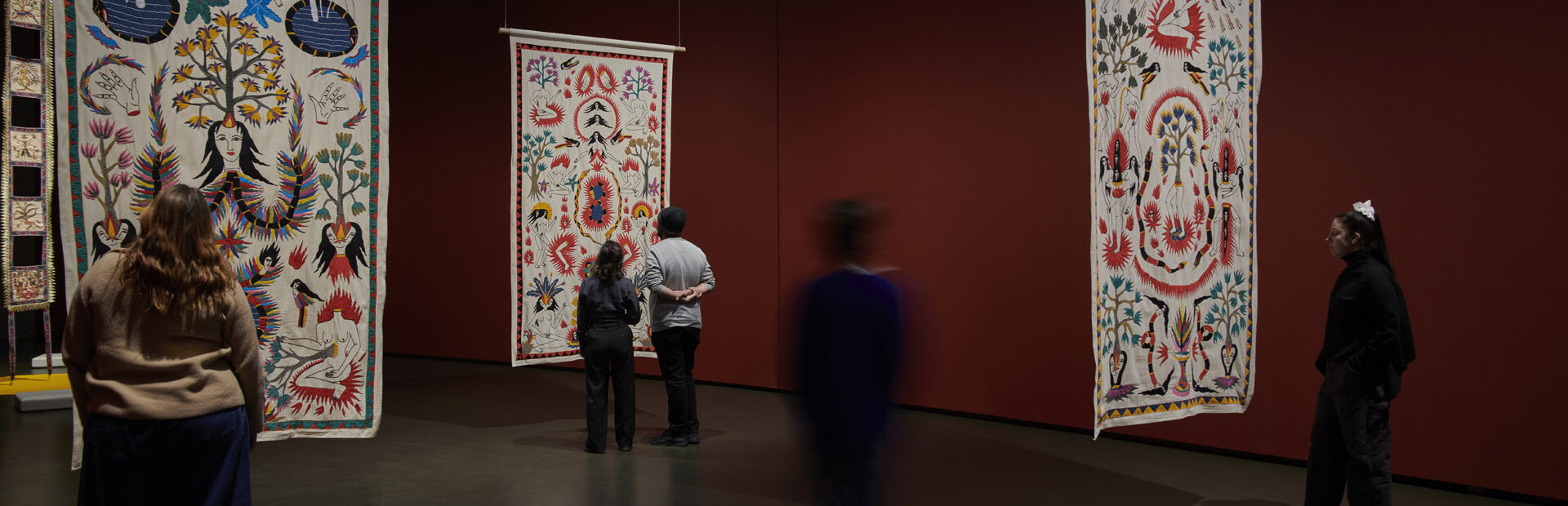
AWDB speaks to renowned Indonesian artist Citra Sasmita in light of her ongoing solo exhibition at The Barbican Centre in London, ‘Into Eternal Land’. Her work is concerned with Balinese culture, both in bringing it to the forefront of contemporary art, and in exposing its colonial and patriarchal history. She works across painting, sculptural installation, embroidery, sound, and scent to explore these power systems.
Her work exclusively depicts women, writing them into historical epics across cultures as they undergo transformation and reincarnation. She often uses traditional Balinese techniques, such as Kamasan painting, which was historically practiced exclusively by men and placed women in passive and sexualised roles. Sasmita reclaims this practice, repositioning women to the forefront and challenging the representation of women in Indonesian classical art.
The theme of feminism in your work is generally universal, as an idea, however, being exhibited in London, your work also serves the dual purpose of both bringing Indonesian culture to a western audience and also, retelling it. How do you overcome the challenges of that in your work?
During my creative process, I consciously let go of various expectations and work solely based on the knowledge I have inherited, which serves as my foundation for creating artwork. What I present reflects the resonance of that knowledge and allows people to perceive the roots of my Balinese culture through their own frames of reference.
The challenge I face is how to elevate the discourse on feminism within the traditional and post-colonial cultural context we have inherited in Bali, making it a crucial and relevant discourse for discussion in a more global context.
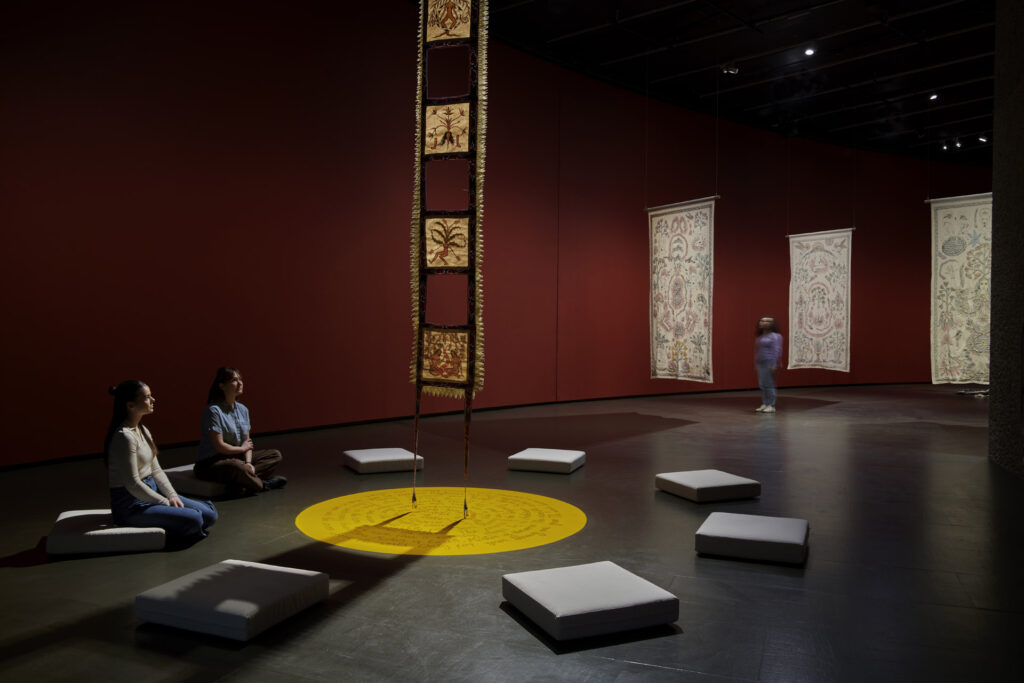
Understanding that your work in ‘Into Eternal Land’ is inspired by Hindu epics like ‘The Mahabharata’ and mythologies from other cultures, such as ‘Dante’s Inferno’, could you enlighten us about what some of the recurring motifs and symbolisms in your work signify in relation to those legendary works? For example, snakes and trees appear throughout the exhibition.
The relationship between the archetypal narratives inherited in Bali and the narratives found in other parts of the world serves as the motif and narrative patterns in the Timur Merah Project. However, I do not explicitly illustrate these narratives in my paintings. Instead, I reinterpret them into a more primordial and transcendent semiotics.
Similarly, this practice mirrors that of Hindu priests in Bali who create drawings of rerajahan—symbolic images that functionally resonate with with a lot of aspects of traditional Balinese life such as making drawings in rituals for protection, rituals for death that guide spirits to the realm of ancestors, or rituals that bless architectural structures at their inception. The iconography that emerges represents my process of connecting and narrating the relationships between humans and nature, among humans themselves, and between humans and God.
Note to reader: the Timur Merah Project is an ongoing series that Sasmita has been developing since 2019, aiming to re-examine and reinterpret historical narratives of Indonesia and Bali, particularly by centering feminist perspectives. Her work for ‘Into Eternal Land’ continues this series, following in its style and theme.
Across the world, and in Bali, patriarchal culture is still present. In retelling stories that built on and enforced a patriarchal society, have you noticed a shift in reception to your work/in the art world? Does it differ with each country you show it in?
The works I’ve created in the Timur Merah Project have actually served as my way out of the deeply entrenched patriarchal situation in Bali and Indonesia. These works have connected me with artists, activists, and academics who are deeply dedicated to this issue, thereby extending their resonance beyond the small context of Indonesia. The appreciation for the presentation of Timur Merah’s works in the global arena, in all the countries that have exhibited my art, has reinforced my beliefs and ideology in support of women’s rights and feminism.
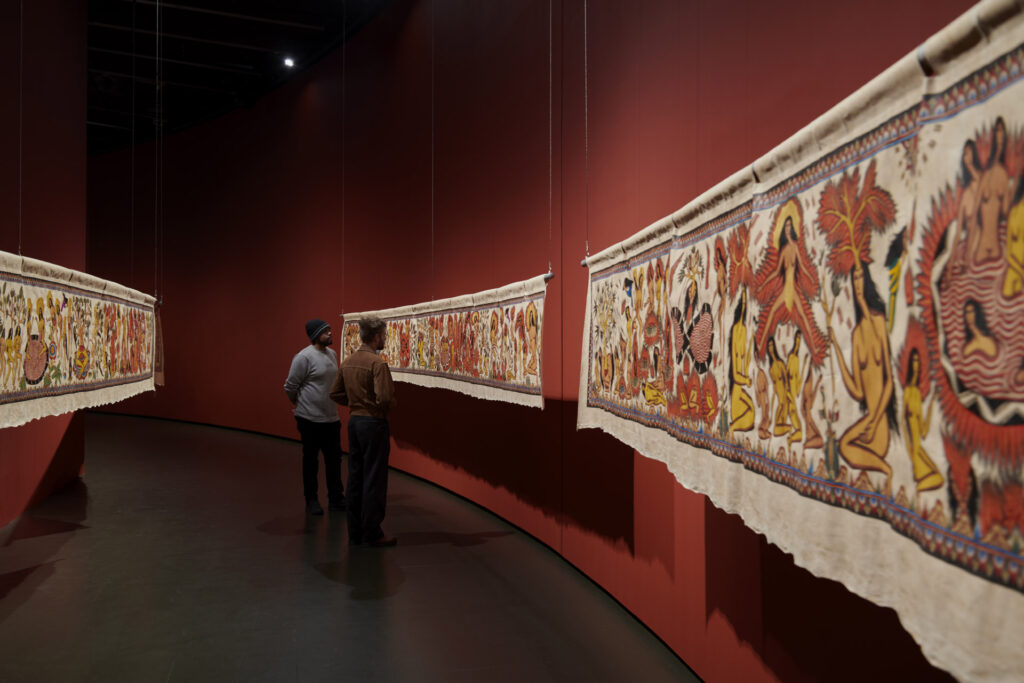
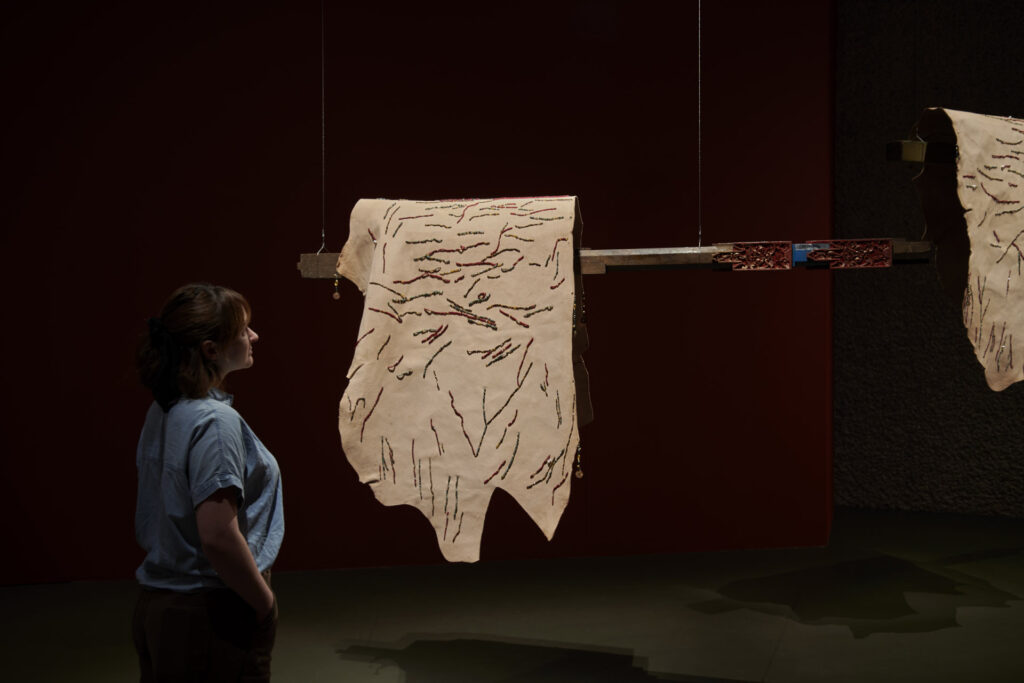
Citra Sasmita, ‘Act Two’ of ‘Into Eternal Land’, 2024, ac rylic on python skin, artificial hair, and found wooden carved mask, dimensions variable. Image by Jo Underhill / Barbican
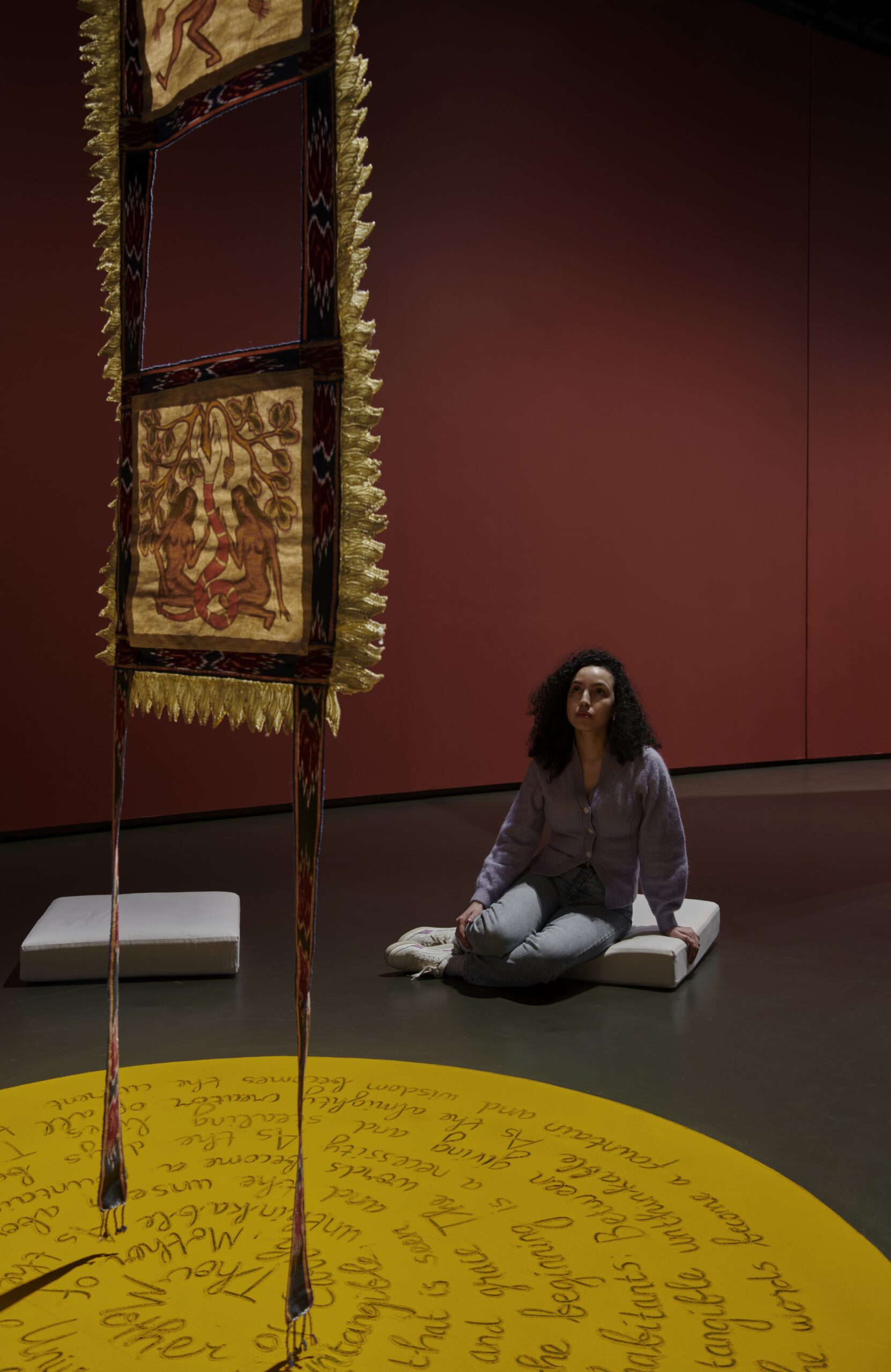
Could you elaborate on your techniques, particularly Kamasan painting in ‘Act One’ and the West Balinese embroidery in ‘Act Three’?
The techniques used in Kamasan painting and embroidery in West Bali are fundamentally different in terms of materials and processes, influenced by geographic accessibility where artisans utilise and develop local materials they find. However, historically, these techniques share similarities in narrative and function as decorations for rituals and temple architecture.
I present these two distinct techniques as a symbolic representation of the cosmological journey from the East (Kamasan Village) to the West (Jembrana, West Bali). On a personal level, this also reflects my process of developing artistic ideas that aim to document the cultural heritage of Bali, which is currently facing a crisis due to modernity.
‘Into Eternal Land’, at first glance, appears to be a visual art exhibition. However, from my perspective as an artist, it represents a series of rituals that I present to The Curve Gallery at the Barbican Centre, in appreciation of the space’s dedication to culture in London. In Balinese rituals, offerings are presented in a complex manner that goes beyond visual elements; they also involve sensory experiences such as aromas, music, and the dramaturgy created by the people involved.
The character you depict in the exhibition, and throughout your work, is the same, even across different mediums. What does this unity represent? Does it reflect the inherited histories of women?
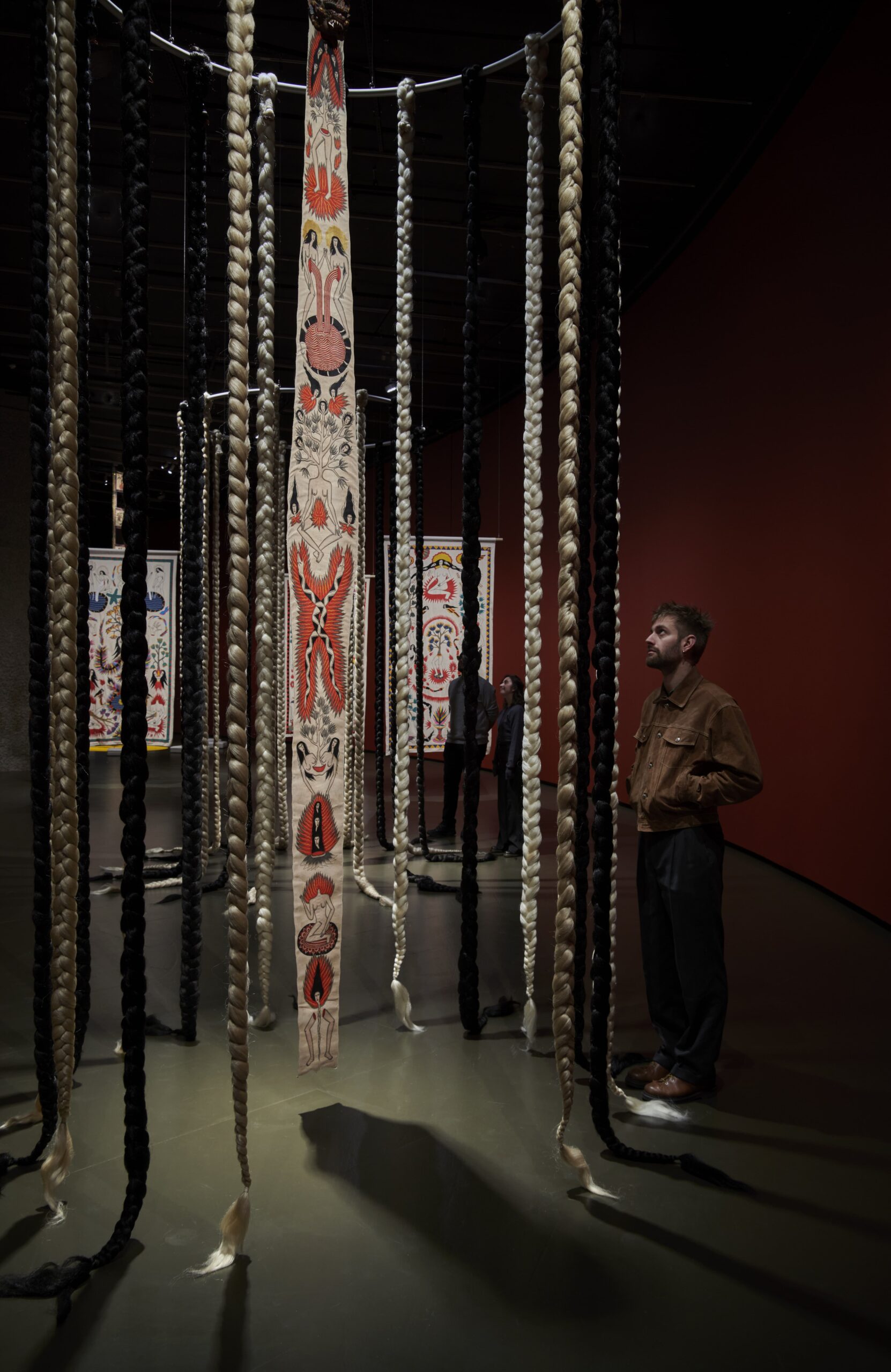
The characters I present are comparable to an alphabet. What people can understand is how the impression of a visual transforms the iconography into a cohesive narrative within the installation, and how the experience unfolds spatially. Therefore, the works in ‘Into Eternal Land’ cannot be analysed in a fragmented or partial manner. The paintings, installations, and the flow of sound within the space create a holistic experience from beginning to end.
Repetition is an intriguing aspect to discuss here, as culturally and spiritually, the Balinese believe in reincarnation, cycles, and the idea of repetition in all facets of life. In the context of art, before being influenced by colonial painters concerning durability and individual autonomy in creation, the Balinese engaged in art communally and anonymously. Once the ritual’s purpose was fulfilled, they would conduct a pralina ceremony (where, after giving life to the artwork, they would burn it once the ceremony concluded). This practice has been passed down through generations, allowing us to maintain the belief in our ability to create art without forgetting its essence.
The colour red is prominent in your work. For the viewer, red is kind of jarring, and could be seen to depict violence, especially alongside some of the imagery. Is this a reaction you hope to evoke?
Throughout my work, whenever I present the color red, no one has ever commented that it signifies violence. This is because my initial intention in creating art is not to depict violence. One of my goals is to achieve enlightenment, and the difficulties encountered during the process may be captured in one of the fragments. Fortunately, the resonance and appreciation I have received stand in stark contrast to notions of violence, focusing instead on aspects of empowerment and the transcendence of knowledge, as well as the potential that individuals can reach beyond their perceived limits, especially regarding spirituality and a yearning for alternative lifestyles that urban society often lacks. Therefore, we need a more comprehensive, holistic view in appreciating the work ‘Into Eternal Land’ to avoid the fragmentation that does not represent the essence of this piece.
‘Into Eternal Land’ is currently on show at The Curve Gallery inside the Barbican in London until 21 April 2025. For more information, please click here.
INTERVIEW COURTESY OF ART WORLD DATABASE AND CITRA SASMITA, MARCH 2025.